


Cecilia Pfeiffer de Widt: Storyteller and Digital Artist

Cecilia Pfeiffer de Widt is a storyteller at heart. Through her unique approach to digital art, she intertwines history, imagination, and photography to create evocative pieces that spark curiosity and conversation. Her work is deeply rooted in storytelling traditions, influenced by her heritage, her passion for Indigenous histories, and her love of nature. Cecilia will exhibit her work at the Local Artist Expo at The National Parks Store on March 28 and 29, 2026, from 10 AM to 5 PM, with talks at 11 AM and 1 PM each day.
We were lucky to have the opportunity to sit down with Cecilia to learn about her journey as an artist and storyteller.

Storytelling, creativity, and heritage
“Storytelling has been in my family, my blood, my whole life,” she shared. “I’m not a historian. I’m not a specialist. But what I do have is curiosity.”
Cecilia did not discover until later in life that her grandmother was Choctaw. Her Indigenous heritage was whole area of her life that wasn’t spoken about during her childhood. When it finally came to light, Cecilia felt a deep passion and commitment to sharing the stories of Indigenous peoples through her art. So, with a tremendous amount of careful research, Cecilia helps share these stories through her art and interpretation.

“Eagle Warrior Tethered To The Earth” by Cecelia Pfeiffer de Widt
An unconventional start
Cecilia’s journey into digital art was not conventional. With a background in IT and public speaking, she spent years engaging audiences with stories that brought technology to life in unexpected ways. However, her artistic path truly began when a friend, an architect and oil painter, encouraged her to try digital art. With a free digital art package and a deep well of curiosity, she embarked on an exploration of creativity that quickly became her passion.

“Chili Casa” by Cecelia Pfeiffer de Widt
Weaving together research, imagination, and narrative
Unlike traditional digital artists who rely on styluses and Photoshop, Cecilia paints with her crooked finger and the side of her thumb—hence the name, “Crooked Finger Digital Art.” She describes her process as a blend of instinct, imagination, and iteration, often working through ten to twenty versions of a piece before she finds its final form.
Each piece begins not with a concrete image but with an idea, a story, or a historical curiosity that she researches in depth. Her inspiration can come from anywhere—a book, a legend, or even a documentary. From there, she weaves together her imagination, historical research, and photographic elements to create layered, narrative-driven compositions.
Artistic collaboration
One key collaborator in Cecilia’s artistic journey is photographer Kathleen Pierz, who shares her love for national parks, history, culture, travel, and nature. Following a career in international strategic planning, Kathleen took her casual photography hobby and transformed it into a genuine pursuit. She travels the country and the world documenting the details of daily life – both human life and wildlife. She leverages her artist’s eye to capture unique moments and compositions of shapes, light and color to tell a story.
Kathleen, an avid traveler in her self-retrofitted van, captures breathtaking images of wildlife, landscapes, and historical sites. Their collaboration is symbiotic—Kathleen provides Cecilia with an array of photographs based on themes or subjects that intrigue her, and Cecilia transforms them or incorporates them into some of her digital pieces.

“The Huntress” is a tribute to Running Eagle Blackfeet, whose father taught her to hunt (courtesy of Cecilia Pfeiffer de Widt).
Narratives of human experience
One of Cecilia’s primary artistic goals is to revive interest in history, mythology, and Indigenous narratives through visual storytelling. She is particularly drawn to the traditions of Indigenous peoples. Her work encourages viewers to engage with these cultures, sparking discussions about their histories and contemporary stories. She believes in the power of art to connect people to forgotten stories and contemporary issues, ensuring that they continue to be shared and remembered.

“Adobe Winter” by Cecelia Pfeiffer de Widt
Artistic, cultural, and historical layering
Her pieces are a fusion of multiple elements—sometimes combining as many as seven different photographs with layers of hand-drawn digital painting. She often integrates unexpected textures and elements, such as incorporating Scottish trees into an Arizona landscape or blending architectural details from ancient castles with desert scenes. One of her most meaningful works, “The Hands That Built Arizona,” pays tribute to the state’s history by incorporating images of a pair of sculpted hands from Wales, symbolizing the labor, craftsmanship, and collaboration behind Arizona’s development.

“Medicine Man Returns Home” is one of Cecilia’s personal favorites (courtesy of Cecilia Pfeiffer de Widt).
The power of art to connect
Cecilia features many Indigenous stories in her work, including her pieces “Medicine Man,” “Girl Born in Snow,” and “The Huntress,” a piece that pays tribute to Running Eagle Blackfeet whose father taught her to hunt. Another piece close to her heart, “Quail Reflection,” is inspired by a quail that visited her home daily after losing its mate. Every morning, Cecilia would feed the quail outside her home. “For two years, there was a couple who came each morning. You know, quails mate for life. And they were so adorable. And one day, she disappeared.” Cecilia captured the widow bird’s mourning and resilience through a combination of photography and digital painting, crafting a visual narrative that mirrors the universal themes of loss and perseverance. Each of her framed works includes a written story, reinforcing her belief that art should not only be seen but also read and felt.
Meaning in the eye of the beholder
Cecilia thinks deeply about the power of storytelling and its broader impact on the world. “If we had been taught as children, or today were taught as children, the enthusiasm of history, not through rhetoric, not through facts, not through droning lectures, but through the power of storytelling, we might have a more empathetic world to live in.” This is a palpable feeling evoked by her work, which feels very personal, as though inviting us into it to enjoy and understand it from our own perspectives. Her art is not about adhering to rigid techniques but about bringing people into a dialogue with history, culture, and imagination.
By merging research, photography, and her own creative vision, Cecilia creates pieces that serve as both visual and emotional journeys. Whether depicting a a story of deep personal significance or capturing the iconic beauty of nature, her art invites viewers to pause, reflect, and engage in conversations that bridge past and present. Through her work, she hopes to bring history back into everyday life—one digital painting at a time.
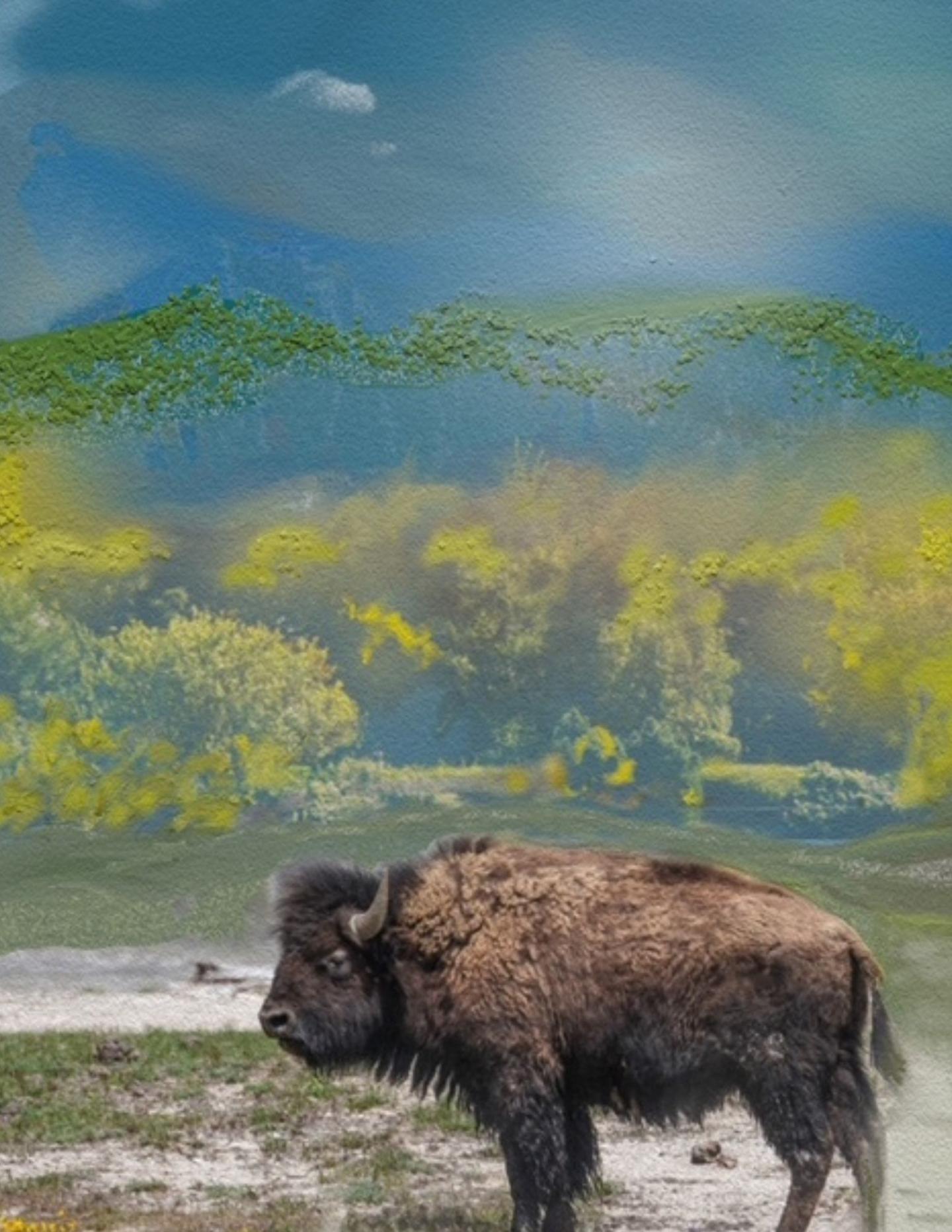
“Bison” beautifully depicts an animal with a tragic past and, through the efforts of many, has resiliently survived (courtesy of Cecilia Pfeiffer de Widt).
Don’t miss Cecilia’s talk at 11 AM and 1 PM on both days of the Local Artist Expo at The National Parks Store March 28 and 29.
By Julie Thompson

