


Experience the fall bird migration in these eight national parks

If you're looking to go bird watching for the first time or are looking to add another species to your life list, visiting a national park in autumn is a perfect opportunity to spend some quality time outdoors with your favorite feathered friends. Every year, from late August through early November, millions of birds from hundreds of different species migrate south.
National parks protect habitats along these migration routes that birds use to "stop over" on their long journeys.
This means you can not only see resident, nonmigratory birds at these parks, but also many other species that are just passing through. For first-time birders, fall migration offers an opportunity to try this popular outdoor pastime—and you don't have to be able to identify different birds in order to enjoy them.

Anyone can be a birder
“There's a misperception that knowing something about birds comes before becoming a birder, but the truth is—just going or even looking outside, turning on your Merlin app or opening your ears, is all it takes,” says Lindsey Stone, Board President of Birdability. This nonprofit organization works to ensure that the birding community and the outdoors are welcoming, safe, and accessible for people with disabilities and other health concerns by hosting events and providing valuable resources on inclusivity and accessibility.
Lindsey also serves as the Associate Director of Learning and Development at Western National Parks. “You don't have to be able to name a single bird to get started birding, but once you start, I can promise you'll begin to notice a startling, rich world everywhere you look, and you'll be surprised at how quickly the knowledge will follow.”
For those with more experience, fall migration is a time to search for birds that may not easily be found at any other time of year. Before you start planning your trip, take a look at some of our tips for preparing for a birding adventure.

What do I need to go birding for the first time?
The following gear is essential no matter what your experience level is, so you can enjoy plenty of time outside.
- Sun protection and layers of clothing. Birding requires patience, and birds are often most active around dawn. Fall weather often means temperatures are cool in the morning and warmer during the day, so dressing in layers and opting for sunglasses and a wide-brimmed hat are good choices.
- Sturdy shoes. Although you may not need to hike or walk very far while birding—oftentimes birders say that parking lots are some of the best spots—wearing sturdy shoes makes any birding experience better.
- Plenty of water and snacks. Staying hydrated and having plenty to eat means you can take more time to look for birds. Just be sure not to feed your feathered friends.

What do I need to identify birds?
One of the joys of bird watching is finding different species and appreciating how each is unique. The following gear will likely be helpful.
- Binoculars. While they don’t have to be expensive, binoculars will allow you to observe birds that are farther away.
- A field guide. You can use a paper field guide, which has photos and information about birds, or an app on your phone such as Merlin BirdID, which also allows you to record bird calls and identify them.
- A bird checklist. Using a birding app such as eBird allows you to log the species that you can see. Many national parks also create birding checklists that are available either online or at the visitor center. These checklists are a way to narrow down what species you are likely to see—plus it’s a way to make birding into a fun “bingo” game.
Finally, if you're visiting a park during the fall migration, there may be special ranger programs focused on birding. Check the NPS website for additional details.
Where can I see birds during the fall migration?
Courtesy of North Dakota Game and Fish Department
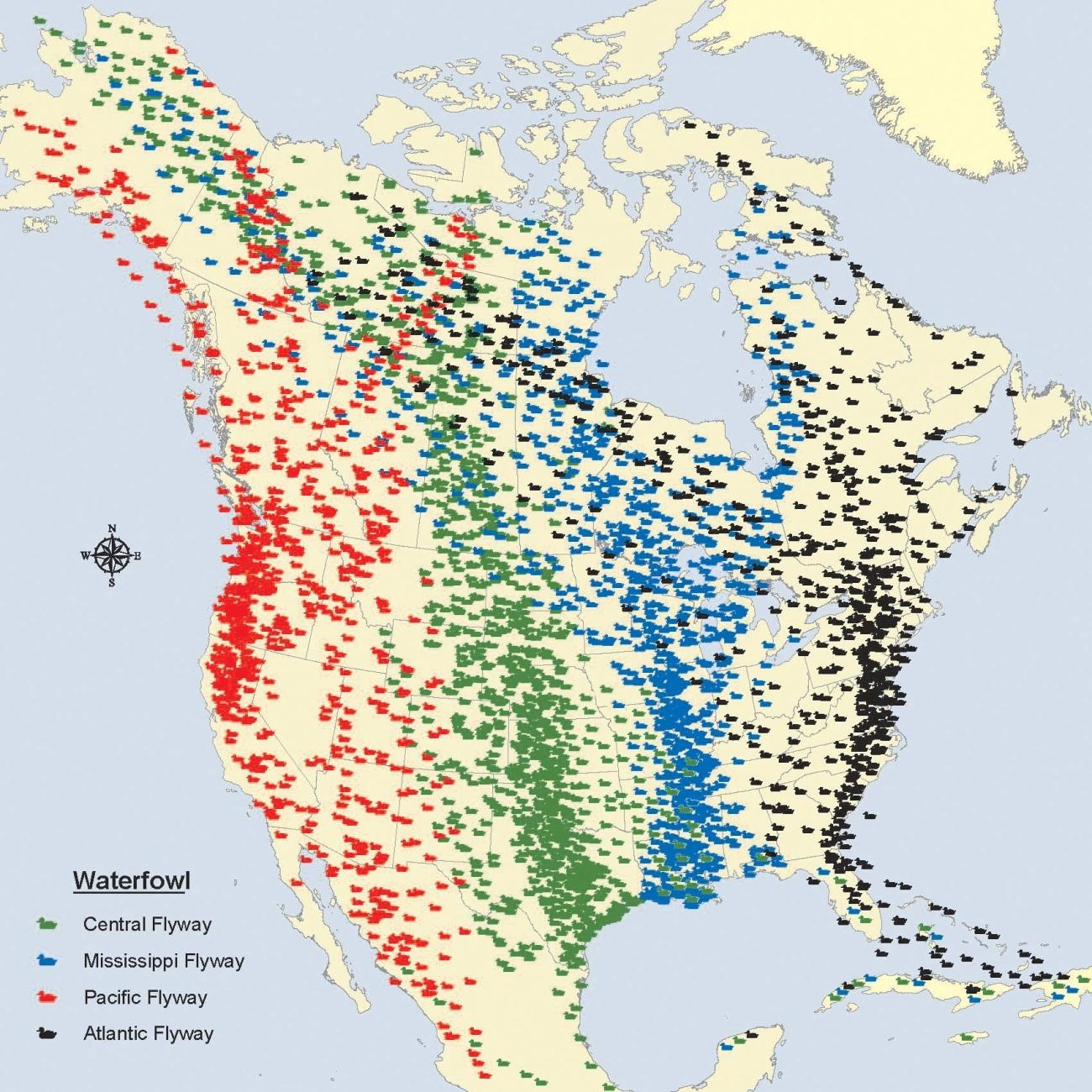
In North America, birds migrate along four major flyways—Atlantic, Mississippi, Central, and Pacific. Each flyway has different species present, so you can choose where you want to travel based on what birds you want to see.
Many western national parks are located along the Central and Pacific Flyways. The Central Flyway crosses Texas, New Mexico, Oklahoma, Kansas, Colorado, Wyoming, North and South Dakota, Nebraska, and parts of Montana. More than half of migratory waterfowl in North America make their journeys along this path, and it is also the route that the sandhill cranes use to migrate. The Pacific Flyway crosses Arizona, Utah, Idaho, the remainder of Montana, California, Nevada, Oregon, and Washington. Many birds use this flyway, including hummingbirds, songbirds, and some shorebirds.
Birds to see on the Central Flyway in fall


1 of
National parks to visit on the Central Flyway

Great Sand Dunes National Park and Preserve, Colorado
Nestled in the Sangre de Cristo Mountains, this remote national park protects the tallest sand dunes in North America. More than 250 different species have birds have been seen here, due to the different habitats located within the park. More than 20,000 sandhill cranes migrate through this valley and can be seen from September through mid-November. The nearby Monte Vista National Wildlife Refuge, which protects a wetland habitat, is a popular place for viewing birds.
Looking for more to do? Great Sand Dunes has stunningly dark skies, hiking trails that wind through aspen forests, and opportunities for backpacking and camping. Plus, you can rent a sandboard and sled or board on the dunes.

Big Thicket National Preserve, Texas
This highly biodiverse area of Texas has over 300 documented species of birds, with 74 known species of birds nesting in the park. During the fall, you can see species such as ruby-crowned and golden-crowned kinglets, blue-headed vireo, and Swainson’s and yellow-rumped warblers. The park even has a dedicated trail that is great for birding. The 0.75-mile Birdwatcher’s Trail has views of the Trinity River and Menard Creek, which birds use to navigate as they make their journeys south each year.
Enjoy fall foliage when you hike or mountain bike in Big Thicket. You can also paddle and canoe on one of the park's many paddling trails, including the Lake Bayou Paddling Trail or the Village Creek Paddling Trail. If you've never gone canoeing before and want to learn, the park hosts free learn-to-paddle programs, led by park rangers, as well as guided paddling tours for more experienced kayakers.

Amistad National Recreation Area, Texas
This park, on the border of United States and Mexico, is a highly diverse area where three different ecosystems meet, making it home to species found across both North and South America in desert and woodland habitats. The park's five campgrounds also make excellent places to start birding. Among the many migratory species you can see here are eared grebes, Anna's hummingbird, the violet-crowned hummingbird, and a wide variety of shorebirds and waterfowl. There have also been reports of the Montezuma quail in the park, and all three species of kingfishers found in North America—ringed, belted, and green—can be found at Amistad throughout the year.
After you spend a day finding birds, go for a paddle on the reservoir. Or time your visit to coincide with the monarch butterfly migration, as thousands of butterflies stop in Amistad to roost before continuing their journey to Mexico.
Birds to see on the Pacific Flyway in fall


1 of
National parks to visit on the Pacific Flyway

Chiricahua National Monument, Arizona
With over 200 species of birds and identified as an "Important Bird Area" by American Bird Conservancy, Chiricahua National Monument is known for the many rare species that make their way through this area during the fall migration. Popular birding trails include the Bonita Creek Trail, Silver Spur Meadow Trail, and Echo Park.
Want to spend more time in Chiricahua after you finish birding? Make the scenic drive to Massai Point or spend a night or two in the Bonita Canyon campground.

Coronado National Memorial, Arizona
Located on the border of Arizona and Mexico, Coronado National Memorial has many notable bird species, including a variety of hummingbirds and the elusive Montezuma quail. Among the many species you can see here during this time are the Western wood pewee, Hammond's flycatcher, grey flycatcher, warbling vireo, ruby-crowned kinglet, and many species of warblers.
After you check off a few lifers, make the drive to Montezuma Pass to take in the views. You can also hike to Coronado Cave and stop by the visitor center to enjoy the many exhibits about the history of this area.

Pinnacles National Park, California
Pinnacles National Park is known for the California condor, one of the most critically endangered species of birds in North America. If you are lucky enough to see one of these birds within the park, the park encourages you to report the sighting and provide the studbook number (the tag number of the bird). This helps scientists at Pinnacles and throughout California track and manage these important species, which live in the park year-round. The best place to see these birds is on the High Peaks trail in the early morning or evening. Other popular areas to bird include the Pinnacles Visitor Center and campground, the Bear Gulch Nature Center, and the Balconies Trail.
If you're looking for more to experience, hike one of the park's many trails, go rock climbing, or stay at one of the campgrounds and go stargazing.

Channel Islands National Park, California
This remote national park is known for its many unique bird species, as the habitats are isolated from the mainland. Each island has endemic birds—some only found on a single island, giving the park the name the "Galápagos of California". The endemic island scrub-jay, for example, is found only on Santa Cruz Island and nowhere else in the world. There are also a variety of seabirds that nest on the islands. Shorebirds can also be found here, although the park recommends seeing them on Santa Cruz, Santa Rosa, and San Miguel Islands.
Once you're done checking off so many different species, be sure to explore the rest of the park. Enjoy a hike along the ridgelines, visit the tide pools, and camp overnight at Scorpion campground and enjoy a sky full of stars.
World Migratory Bird Day
Celebrated on the second Saturday of May and the second Saturday of October, World Migratory Bird Day is an opportunity for everyone to learn about birds and their habitats and participate in community science events. National parks and nearby cities may host events in and around this special day—including group birding outings. Contact the park you are interested in visiting to learn more about these, or other ranger programs connected to birds.
Tips for birding

Be patient and aware
Spotting birds requires time, and the willingness to potentially remain in one place for a while. Take it slow and enjoy being immersed in nature as you do.

Give birds room
National parks protect important habitats for birds, including nesting grounds. Use binoculars or a scope to observe birds from far away.

Contact the park
Some parks may have restrictions on when and where you can hike to see birds, to protect their nesting grounds. Other parks or local conservation chapters, like the Audobon Society, may host programs designed to educate you about birds. Ask the park you plan to visit for more details.

Bring your camera
You may want to take pictures of birds that you see—both to help you identify them, but also as a park memory.

Have fun
It's okay to just enjoy looking for birds, and hearing birdsong, without identifying them. If you are a first timer, ask to go birding with an experienced friend or as part of a park program.
1 of
More birding events
Fall migration is just one opportunity to go birding in parks. You can also participate in events like the Christmas Bird Count, Great Backyard Bird Count, or other local birding events. The fun thing about birding is that because birds migrate in fall and spring, each time you visit a park, you're likely to see new species. It's just another reason to go to a park again and again.
By Nikki Stavile


