


Artist Spotlight: Christine Jarus, Painted Drawings of Nature

Christine Jarus will exhibit and sell originals and prints from her latest body of work, “A Celebration of Saguaros,” at the Local Artist Expo at The National Parks Store on March 28 and 29, 2026. Western National Parks had the opportunity to interview Christine about her artistic journey, process, and ways the environment inspires her work.
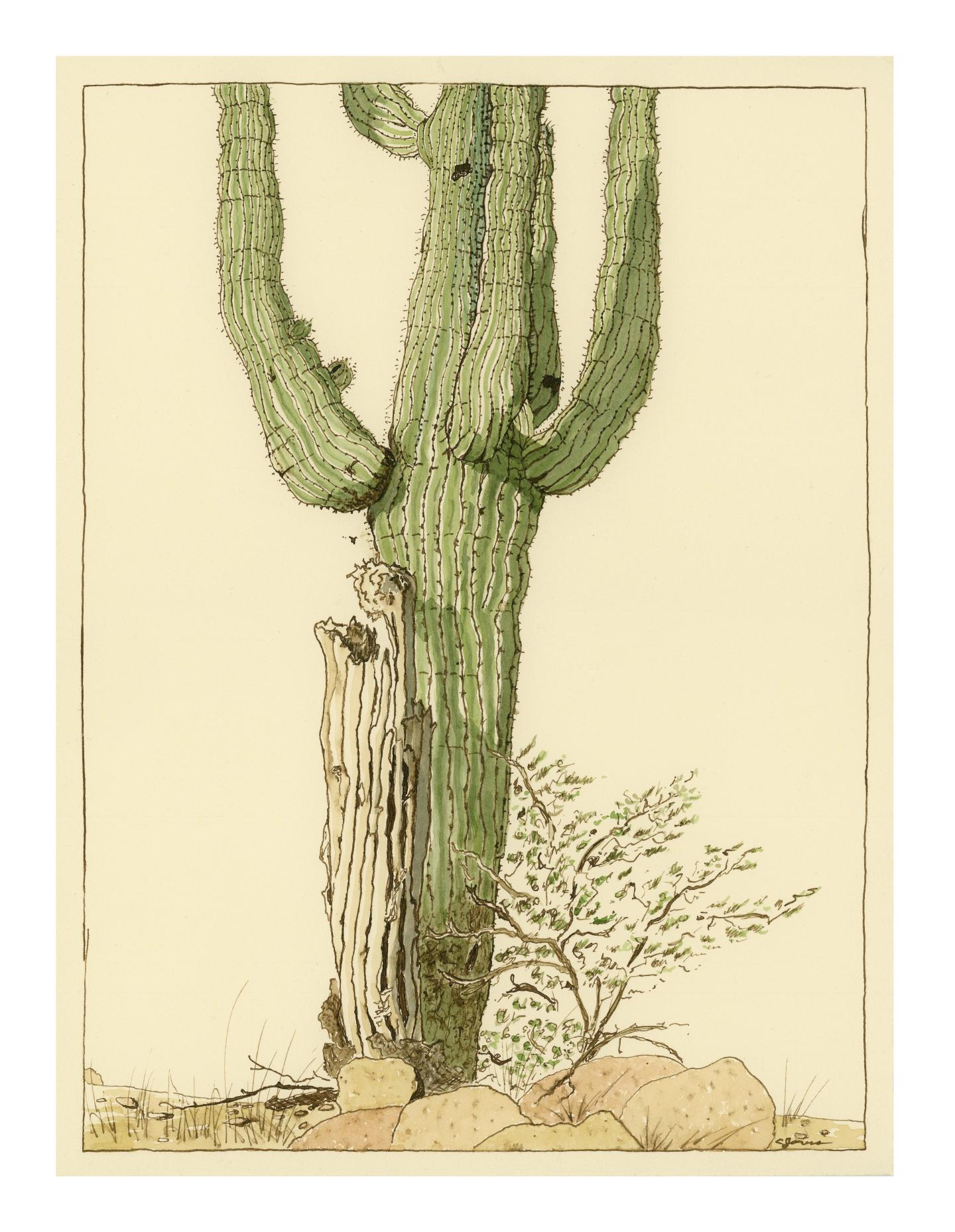
Old Saguaro (Courtesy of Christine Jarus).
An early love of art and nature
One of five children, Christine Jarus grew up in southern Ohio in an artistic family. “Art supplies just appeared in my life as a kid,” she said, “and the interest and love of art came to me quite naturally.” Her grandmother was a china painter and taught Christine how to paint plates and emphasized basic techniques on how to create light and shadow. Christine’s parents quietly supported her creative endeavors, which included paint-by-numbers. The family also regularly took outings to nearby Hocking Hills.
“My mom and dad were birdwatchers and would hand the binoculars to me and my siblings so we could see the beautiful woodland birds,” Christine said. Later, when she began her career as a medical technician and moved to Montrose, Colorado, Christine took this love of nature with her. She continued her artistic education, which she describes as mostly self-taught. She enrolled in several six-week art classes and also practiced regularly using the techniques outlined in Drawing on the Right Side of the Brain, by Betty Edwards. “I refer a lot of people to this book who claim that they can only manage to draw stick figures,” she says.
Art in the outdoors
After she moved to Colorado, Christine began to draw trees she found in the mountains. Later, when she and her husband Daniel began visiting Tucson and Catalina State Park, she started drawing the saguaro cacti.
Her highly detailed artistic process is closely tied to camping, hiking, and spending time outside. “Painting outside and sitting in the beauty honors me with an appreciation and connection with nature that I cherish,” she says. She refers to her intricate painted drawings as portraits, since each cactus or tree is a unique individual.
Each picture takes several mornings and many hours to complete, with a saguaro portrait involving six to nine hours of work and a tree portrait requiring 12 to 18 hours—each image is created over what is often a four–to–five–day camping trip. This, too, can have its challenges. Her series featuring the rock formations at Arches National Park required making camping reservations months in advance to secure a spot at this popular park.
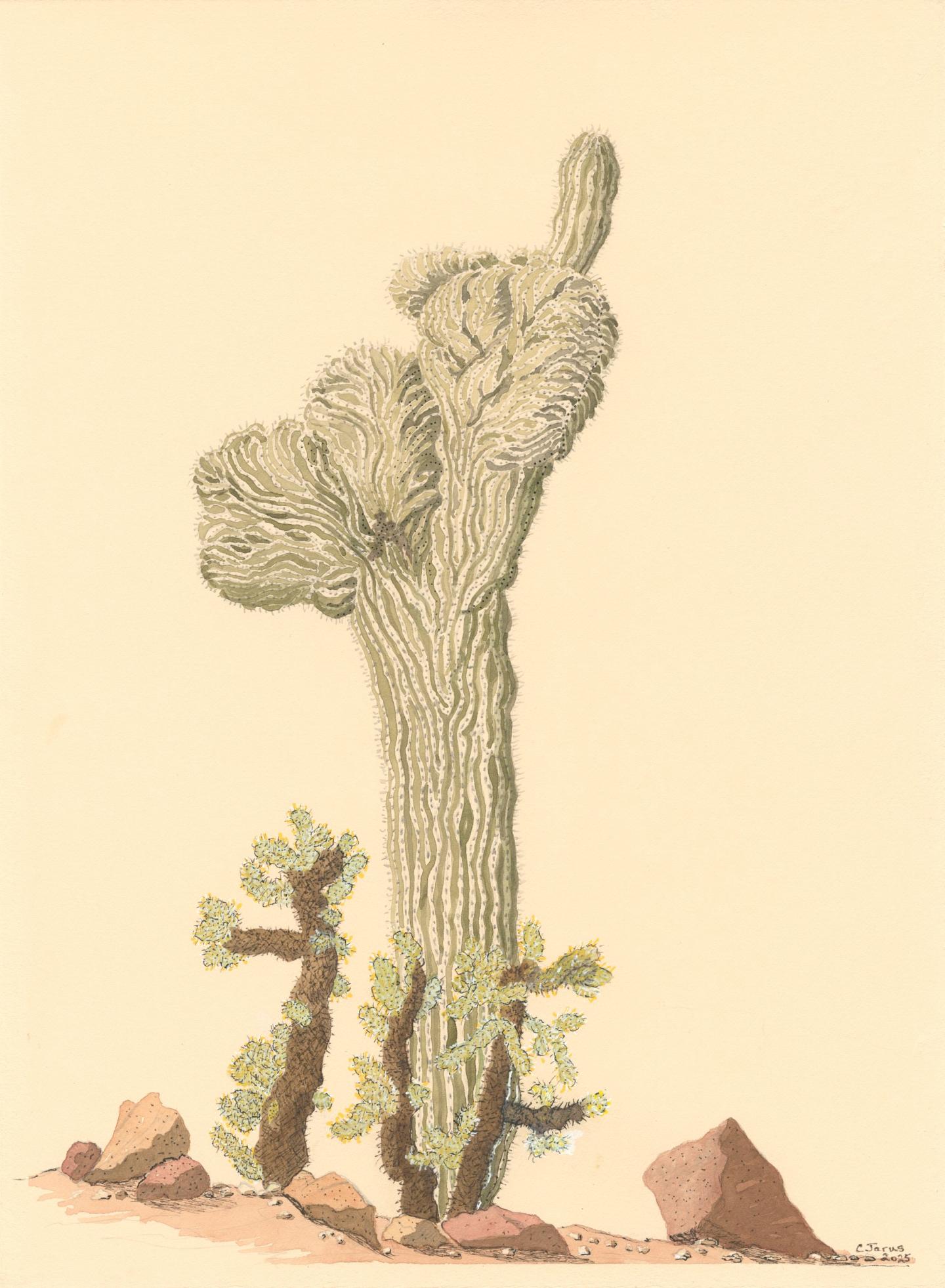
Crested Saguaro (Courtesy of Christine Jarus).
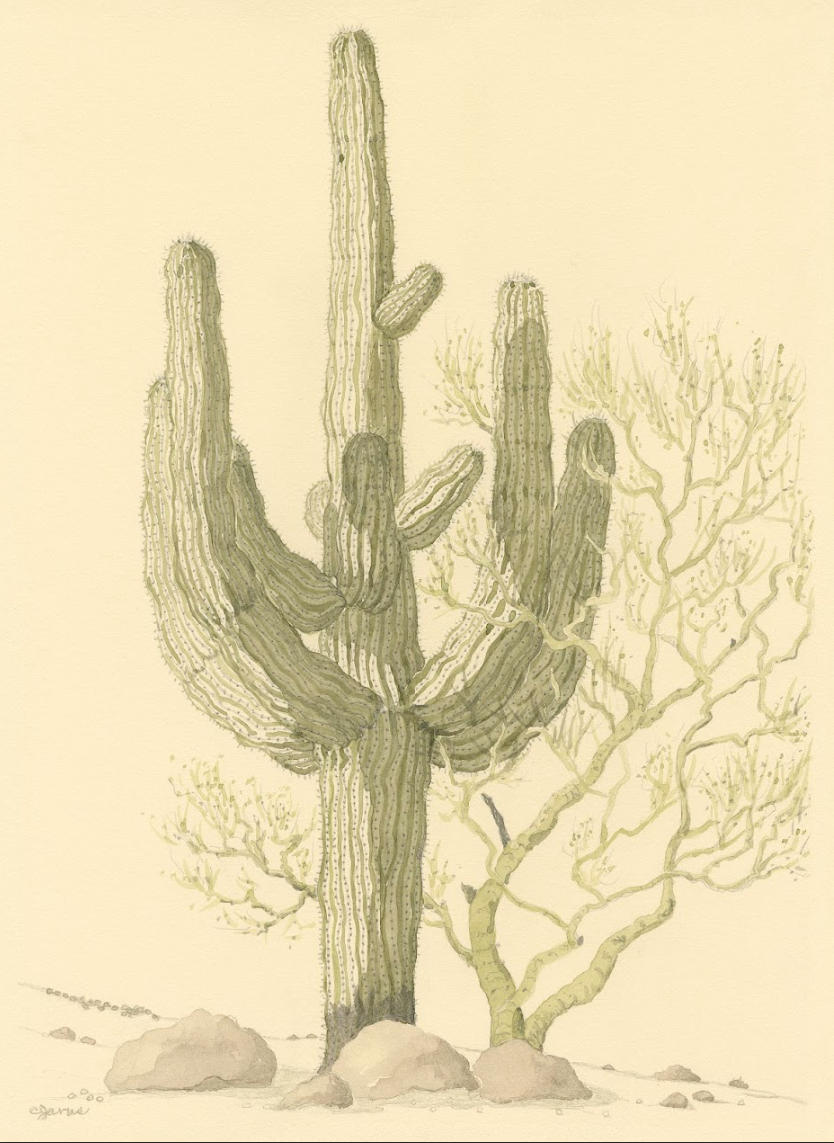
Nursery Tree Protector (Courtesy of Christine Jarus).
Creating a painted drawing begins with getting up in the morning and hiking to a subject she likely scouted out the day before. Some of the choice of subject matter is also logistical, as she has to be able to set up her chair for a day of painting. She brings her sunhat, plenty of sunscreen, tinted printmaking paper, pencils, walnut ink, watercolors, and anything else she needs to spend an entire morning outdoors.
After considering the other natural features surrounding her subject, Christine uses a technique called contour drawing to create the image exactly as it will be painted. She pays close attention to the different lines, ensuring they do not overlap. Later—often the next day or two—she adds colored paint and walnut ink and fine detail work. The entire process involves paying close attention to the light, which dictates how long she will be able to work each day. When finished, she hikes all of her supplies back to her campsite, before setting out again the next day, planning carefully to reach her subject at the exact same time in the morning so the light hits it the same way.
Although she intends to keep traveling and painting as long as she can, Christine admits that it is more difficult to complete tree portraits now, in part due to her age. “When I look back at some of the paintings I have made, it’s amazing that I’m the one who created them,” she says. Each tree portrait has a special story behind it. Alligator junipers require intense focus and detail. One painted tree drawing was created during a rainy camping trip, and Christine was afraid her car would get stuck on the washed-out dirt road as she made her way to work that morning. She has also had the privilege of painting the ancient bristlecone pines in Great Basin National Park, one of the many beautiful places she hopes to visit again.
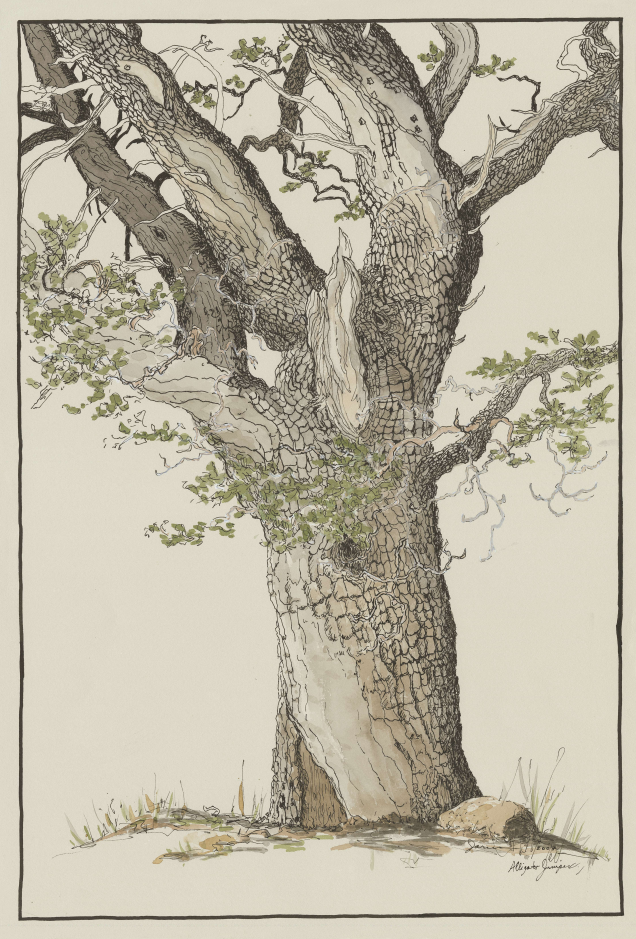
Chiricahua Mountains Alligator Juniper (courtesy of Christine Jarus).
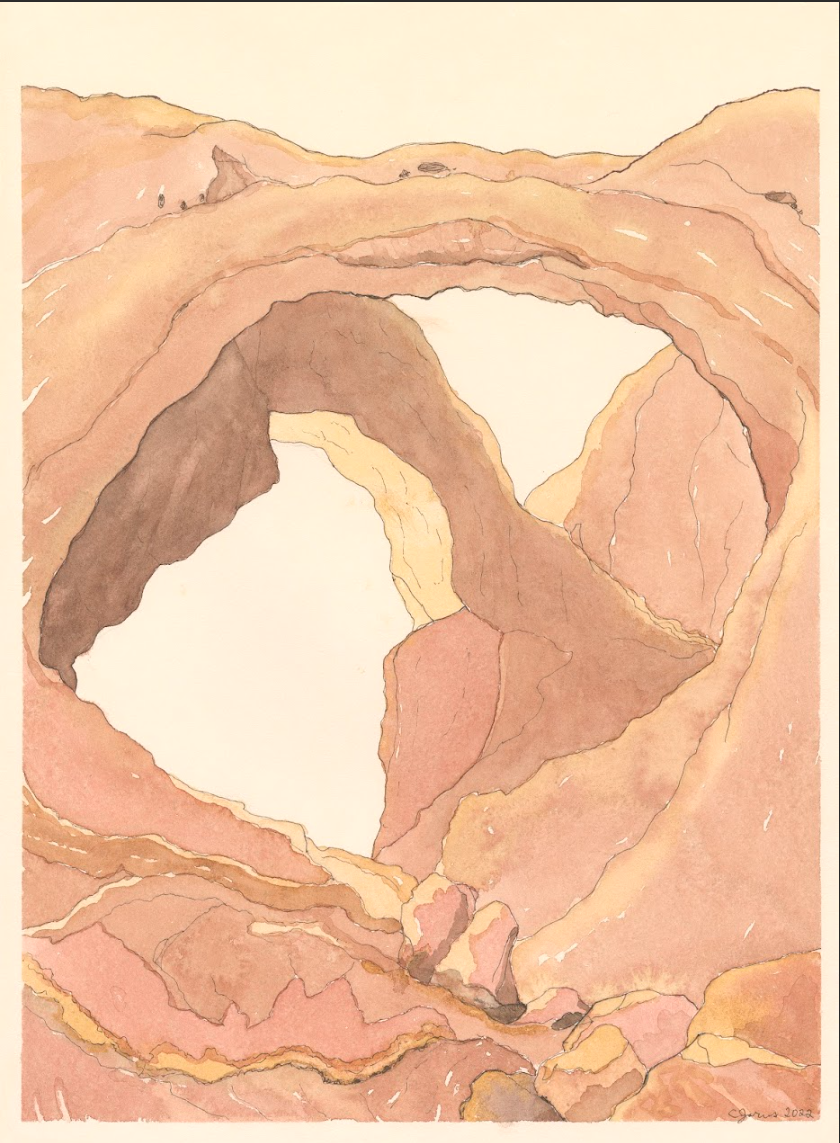
Double arch (courtesy of Christine Jarus).
Giving back to nature
One of Christine’s motivations for creating her painted drawings is a deep concern for the environment. Winters are not as cold, she says, and the temperatures are not low enough to freeze the bark beetles that damage trees in Colorado. Traveling to Arizona each year and driving from Phoenix to Tucson, she is always saddened to see how many saguaro cacti are affected by bacterial necrosis.
Whenever she can, Christine tries to give back to environmental organizations, like the Audubon Society, the Arizona-Sonoran Desert Museum, and Catalina State Park. She also finds the national parks deeply valuable in so many ways, and enjoys chatting with other national park visitors as she works. She finds that these conversations affirm that there are kind people everywhere. For all these reasons, she sees her show at The National Parks Store—her first—as a natural progression in her artistic journey.
Christine also hopes to pass on her love of art, as her grandmother did, to the next generation. She has been tutoring children at a local elementary school in math and reading for three years, and hopes to begin helping out in the art classes soon.
You can meet Christine and browse and purchase her work, at the Local Artist Expo on March 28 and March 29.
By Nikki Stavile


